

Climbing Training Tips from One of the Best Climbers in the World - Seb Bouin

Copy Link


Written by Sébastien Bouin
Climbing Training Tips from One of the Best Climbers in the World - Seb Bouin
5 min readPublished on 19/11/2025 · 14:00
Published on 19/11/2025 · 14:00
Copy Link

About the Author

01. Getting into Climbing
02. Things to Pay Attention to When Starting Training
03. Training Tips for Beginners
04. Regular Exercises for Climbers
05. The Verdict on HUAWEI WATCH FIT 3
06. Integrating HUAWEI WATCH FIT 3 into Training
HUAWEI: How did you get into climbing?
Seb: My mum got me into climbing. She practised many different sports and often brought me along to her activities. One day, she then took me climbing too.
We started climbing outdoors in nature and I was immediately hooked. The combination of the physical challenge and the experience of being in the great outdoors fascinated me from the very beginning. Since that moment, I have dedicated all my free time to climbing. It became my passion, and to this day I can't imagine anything better.

HUAWEI: What did you have to pay attention to when you started training?
Seb: In the beginning, I had to be careful not to get too carried away. My enthusiasm for climbing was so great that I wanted to do everything at the same time - from rock climbing to competitions. I often trained in the evening even though I had been climbing on the rock all day. I risked doing too much and injuring myself. That's why it was important to set myself clear limits and create a structured training framework.

HUAWEI: What training tips do you have for beginners?
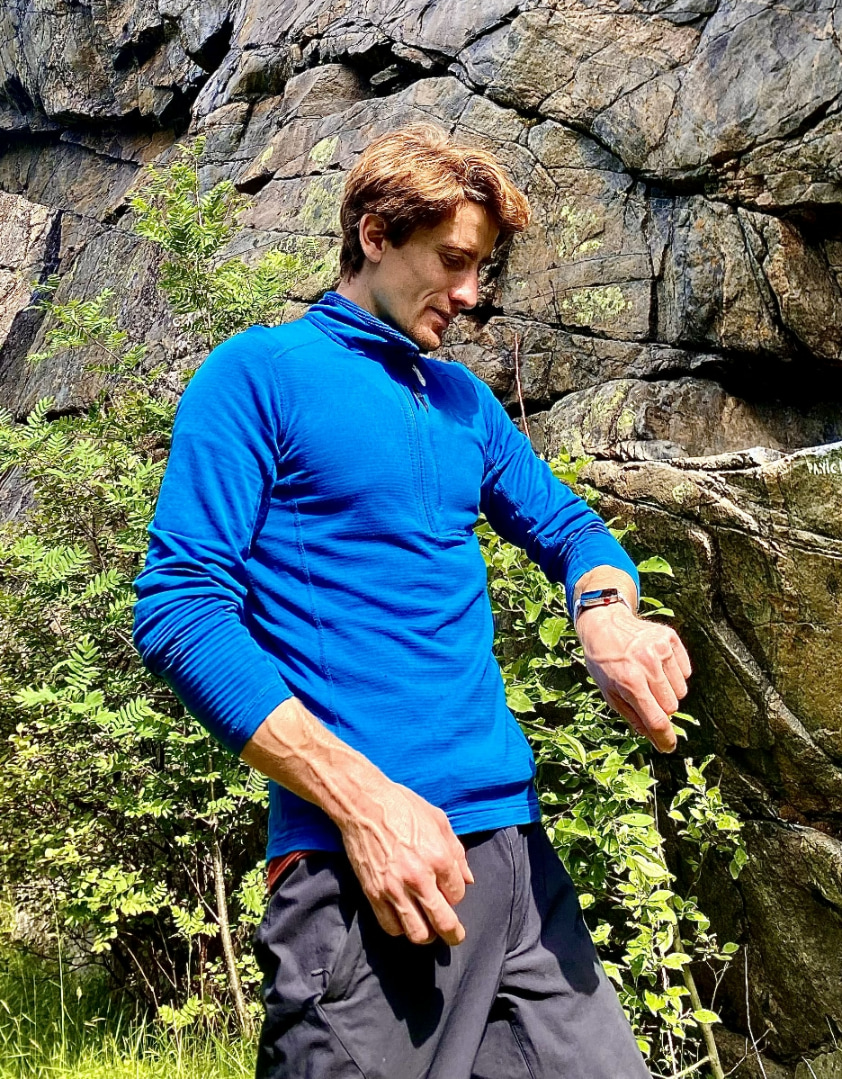
Seb: My most important tip for beginners is to listen to your body in order to make the right decisions at the right time. It can sometimes be difficult to know where you stand physically. This is where a smartwatch like the HUAWEI WATCH FIT 3 can be of great help.

It provides reliable data that supports us during training and allows us to better assess our position. Normally we rely on our gut feeling, but with the smartwatch, we can adjust our exercises even more precisely and optimise our training.

HUAWEI: What exercises should climbers do regularly?
Seb: In addition to the actual climbing, there are several important aspects that climbers should consider:

Strength and endurance training: This is especially important for the arms, to develop the necessary strength and endurance for longer climbing sessions.
Antagonist training: It is important to also strengthen the opposing muscles in order to avoid muscular imbalances and injuries.
Cardio training: An essential part of the sport to increase general training volume and improve endurance.
In anatomy, an antagonist refers to a muscle or muscle group that opposes the movement of another muscle. While the agonist provides movement, the antagonist performs or inhibits the opposite movement to control the movement of the agonist. For example, on the arm:
Agonist: The biceps flexes the elbow.
Antagonist: The triceps extends the elbow when the biceps flexes it.
HUAWEI: You recently started using the HUAWEI WATCH FIT 3 for climbing training. What's your verdict?
Seb: That's true. Normally I never wear a watch when climbing because it bothers me. But I have to admit that the HUAWEI WATCH FIT 3 fits really well thanks to its lightweight and compact design. It didn't restrict me at all when climbing. It allows me to track data, which is something I've never done before. Here are some of the features that positively surprised me:

HUAWEI WATCH FIT 3 GPS tracker: The GPS tracker is particularly useful when travelling in the mountains or in remote areas. It gives you a clear idea of the route you have travelled and is particularly helpful at night or in fog.
Robustness and water resistance: I don't normally wear a watch when climbing, partly because I'm afraid that it will get damaged by knocks or get wet in the rain. But the FIT 3 is robust and waterproof, and therefore ideal for my sport.
Connectivity: The ability to communicate while hanging on the rock without taking out your phone is very practical.
Battery life: The long battery life is particularly suitable for multi-day climbing tours, where recharging is often difficult.
Breathing exercises: A useful function to promote relaxation and controlled breathing after training and before going to bed, but more modes would be desirable.
HUAWEI: How do you integrate the HUAWEI WATCH FIT 3 into your training?
Seb: I have tested the watch in various recreational activities (climbing, running, hiking) and find that it is well designed. The data is reliable and helps me to better understand and adjust my effort in the aerobic and anaerobic zones.
For example, I realised that I was training anaerobically at 160 heartbeats per minute, which was a little too high for the exercise. This allowed me to adjust my training intensity accordingly. The direct feedback between the load and the recorded data is really positive, helps me manage my training effectively, and develop a better sense of my physical condition.
Anaerobic and aerobic are terms used in sports science to describe different energy production processes:
Anaerobic literally means "without oxygen". The body produces energy briefly and intensively from carbohydrates without sufficient oxygen, whereby lactic acid is produced as a by-product. Example: sprinting, weightlifting.
Aerobic literally means "with oxygen". The body obtains sustainable energy from carbohydrates, fats and proteins using oxygen. Example: long-distance running, cycling.
All in all, I can use the HUAWEI WATCH FIT 3 well for my climbing training and can recommend it for beginners who want to learn how to go beyond their limits. What would be perfect for us climbers is a special climbing mode.

Sébastien Bouin
Report
Read more
Explore



Copied