

FTP in Cycling: Training with HUAWEI WATCH GT 6

Copy Link


Written by Agnieszka Skalniak-Sójka
FTP in Cycling: Training with HUAWEI WATCH GT 6
Published on 05/11/2025 · 13:30

Copy Link


Written by Agnieszka Skalniak-Sójka
FTP in Cycling: Training with HUAWEI WATCH
GT 6

As a professional cyclist, I hold my training gear to very high standards. A smartwatch for me isn’t just
a gadget, it’s a training tool that needs to be precise, reliable, and comfortable. Over the past two
weeks, I tested the HUAWEI WATCH GT 6 both on the road bike and on gravel rides in tougher terrain.
First impression: the watch looks very elegant and premium. The octagonal case design makes it stand
out, but it’s not over the top. The smaller 41 mm version I tested doesn’t get in the way during rides.
It fits comfortably even under gloves and long-sleeve jerseys. The rotating crown is a smart addition,
making navigation easy even with sweaty hands or gloves on.
In this guide, I share my experience testing the HUAWEI WATCH GT 6 on the road and in training, while
also exploring how FTP serves as the foundation of effective cycling performance. Functional Threshold
Power (FTP) is one of the most important benchmarks in cycling, shaping how athletes train, pace, and
measure progress. With modern technology, smartwatches and power meters make it easier than ever to
track FTP and apply it to structured workouts.

About the Author

In this article
01. Training Essential: How the HUAWEI WATCH GT 6 Stands Up to Daily Use
02. GPS Accuracy on the HUAWEI WATCH GT 6
03. FTP as the Backbone of Modern Cycling Training
04. Smartwatch + Power Meter Integration
05. Turning FTP Into Training
06. FTP in Racing and At the Professional Level
Training Essential: How the HUAWEI WATCH GT 6 Stands Up to Daily Use
On sunny days, the new AMOLED display really shines. Key data like speed, distance, time, and
heart rate are easy to read without squinting. The Always-On Display works flawlessly, meaning I
could keep an eye on my stats without lifting my hand off the bars. And the best part? With such
a clear and reliable display, I never have to worry about draining the battery on long rides,
battery life is everything. With my training routine (2–3 hours daily with GPS active), the
watch lasted well over a week on a single charge. That’s remarkable, especially compared to
other smartwatches I have previously used, which often need daily charging.
Of course, the watch includes all the standard health features – heart rate, SpO₂, sleep, stress
– but what I cared most about was heart rate accuracy during high-intensity intervals. Compared
to a chest strap, the difference was typically just 2–4 bpm, which is excellent for an optical
sensor. TruSense technology also seems faster in adapting to sudden intensity changes, which is
something that often frustrates athletes with other watches.

I recently tested the HUAWEI WATCH GT 6 on a 105.15 km ride through the Krzeszowice and surrounding areas in Poland, a route that included a mix of forest trails and urban sections. The ride lasted 3 hours and 47 minutes, and my average speed was 27.79 km/h. The GPS accuracy was impressive, especially when riding through dense forests where other devices sometimes struggle. The elevation gain was 946.7 meters, with the altitude peaking at 191.4 meters and dropping to 5.6 meters.

From my perspective, the HUAWEI WATCH GT 6 is an excellent choice for cyclists and endurance athletes who value GPS accuracy, long battery life, and a bright, readable display.
GPS Accuracy on the HUAWEI WATCH GT 6
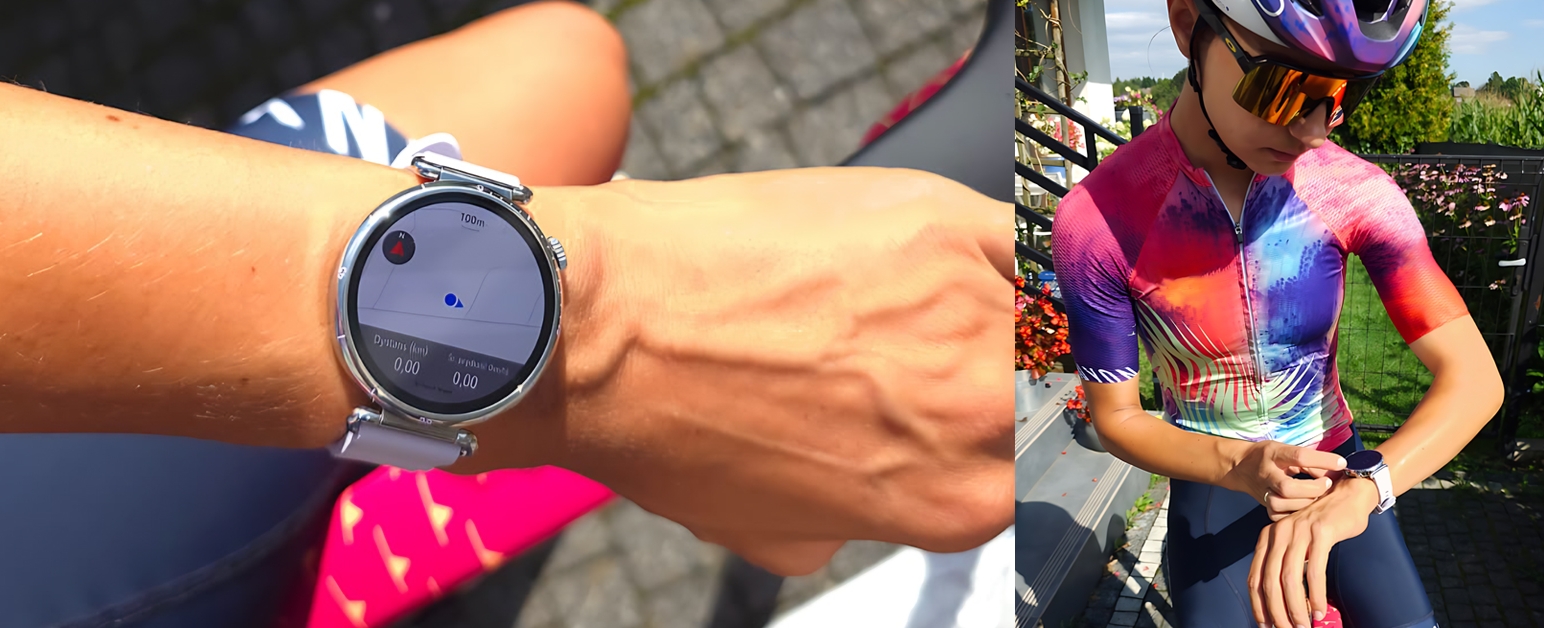
For me, GPS accuracy is absolutely essential, and the precision of the Sunflower GPS 2.0 is
amazing. I can’t compare it to the previous generations, but since I’m testing the device, it
has never missed any turn or misled me. It even recognizes the exact side of the street you’re
on, even when you’re riding through dense forests or cities. The recorded track is almost
perfect, without the ”jumps“ you often see on other smartwatches. Compared to my
state-of-the-art bike computer the differences were minimal – almost negligible. That gives me
confidence in the training data.
The built-in navigation screen offers reliable and easy-to-use route guidance. Similarly, while
syncing with training platforms like Strava works well, there’s some room for improvement also
for offline maps, which future updates may address.
For cyclists seeking a powerful all-in-one solution, this smartwatch provides comprehensive
training data alongside its full suite of everyday smart features.

Accurate GPS and Heart Rate Tracking
Up to 21-Day Battery Life no more battery anxiety for outdoor sports
Pro-level Cycling Tracking with Virtual Cycling Power
Iconic Stylish Design
FTP as the Backbone of Modern Cycling Training
At some point, every cyclist encounters the concept of FTP (Functional Threshold Power). It is a
critical concept for cyclists, both professional and amateur. FTP refers to the highest average
power output (measured in watts) a cyclist can maintain for approximately one hour without
experiencing excessive fatigue. Essentially, FTP marks the point at which lactate builds up in
the muscles faster than the body can clear it away, causing fatigue to set in.
In training, FTP is closely tied to the lactate threshold (LT), which is the exercise intensity
at which lactate begins to accumulate in the bloodstream. When a cyclist exceeds their FTP, they
enter a zone where the body’s ability to clear lactate becomes overwhelmed, leading to muscle
fatigue. Training at or near FTP helps athletes improve their endurance by pushing this
threshold higher, enabling them to sustain higher power outputs for longer durations.
In the following section, I’ll share my firsthand experience testing the HUAWEI WATCH GT 6
during road and training sessions. I’ll also delve into the significance of Functional Threshold
Power (FTP) as a cornerstone of effective cycling performance. FTP stands as one of the most
crucial benchmarks in cycling, influencing how athletes design their training programs,
determine their pacing strategies, and assess their progress. With modern technology,
smartwatches and power meters make it easier than ever to track FTP and apply it to structured
workouts.

Smartwatch + Power Meter Integration
On a daily basis, I use a power meter and a bike computer to control my output in real time.
When training indoors on a smart trainer, I rely on apps that automatically adjust resistance
according to my FTP zones. This makes every session precise and well-targeted.
The HUAWEI WATCH GT 6 aids in tracking and optimizing this FTP testing
process. It actively
records real-time data during the test, such as power output, heart rate, and time. For example,
during my rides, the watch tracks an average power typically ranging around 200 watts. My heart
rate may peak between 160 to 180 bpm during the high-intensity portions, and the smartwatch
captures this data, showing how heart rate correlates with power output.
Once the test is complete, the smartwatch syncs the results with training platforms like Strava,
providing easy access to detailed metrics. The integration with the power meter allows for a
smooth transition from testing to actionable training data, making it easier to track
improvements in FTP over time. This helps me adjust my training zones and fine-tune my workouts,
ensuring consistent progress in my performance. When connected to a power meter, the watch
displays your actual power values. Without a power meter, it provides virtual power values
instead.
FTP is my training anchor – it defines the intensity of each workout. HUAWEI’s WATCH GT 6 helps me to monitor my form, and track progress. This way, I know that every session is personalized and tailored to my current condition.
Turning FTP Into Training
For both amateurs and professionals, FTP serves as a key performance metric. It’s used to set
training zones, tailor workout intensities, and measure progress. In structured training plans,
FTP-based workouts help me to target specific fitness adaptations, such as increasing endurance
or boosting high-intensity efforts.
I regularly perform the 20-minute FTP-test after a solid 15-20-minute warm-up to get my body
ready. During the test, I push as hard as I can for 20 minutes, and then I take the average
power from that duration and multiply it by 0.95 to estimate my FTP. The 0.95 multiplier
accounts for the fact that I can’t sustain my maximum one-hour effort during a 20-minute test,
providing a reliable estimate of my true FTP. Sometimes I also use race data – in competition,
motivation is high, and it’s often easier to hit maximum numbers that can then be extracted as
FTP.
All of my training sessions are based on zones defined by FTP. For example, I may have a workout
with 5 minutes at 120% FTP – a very intense interval designed to improve my ability to ride
above threshold. On the other hand, my long endurance rides are done at 60–70% FTP, which builds
my aerobic base. This translates into a power-to-weight ratio over 4,5 Watt/kg, that aligns with
my pro level. During this session I spent 32:19 min in power zone 4 (228–264 W), 18:29 min in
zone 5 (265–302 W), and 0:58 min above 303 W. My heart rate data showed 57:30 min in the Tempo
range (151–170 bpm) and 1:59 min at Threshold (171–189 bpm), with no time in the VO₂ Max zone.

FTP in Racing and At the Professional Level
Especially at the top level, FTP remains crucial – it tells me how much I can push on a long
climb, how to pace a time trial, or what intensity I can sustain in a long breakaway. Of course,
racing also demands sprint power, tactics, and mental toughness, but FTP is the foundation on
which I build everything else.
The HUAWEI WATCH GT 6 proves to be more than just a stylish smartwatch, it’s
a reliable training
partner for cyclists. With excellent GPS precision, strong battery life, accurate heart rate
monitoring, and seamless integration with power meters and training platforms, it delivers both
everyday convenience and professional-level training support. Combined with its role in tracking
and applying FTP metrics, the watch stands out as a powerful tool for cyclists who want to
optimize performance and training efficiency.

The author of this article is Agnieszka Skalniak-Sójka. The views expressed are her own.
The information is to be used as general information only, and is not to be taken as advice with
respect to any individual situation and cannot be relied upon as such. A healthcare provider should
be consulted when attempting to diagnose a condition or when determining the best course of action
for any health-related concern.
Users should exercise in a safe and suitable manner which is commensurate to their own exercise
capabilities and limits.
The heart rate SpO₂, sleep monitoring and stress monitoring features are not a medical device, and
therefore its monitoring data and results are for reference only and should not be used as a basis
for medical diagnosis or treatment.
Read more
Explore


Copied