

Training for Precision: How Smartwatch Data Enhances Marathon Prep

Copy Link


Written By Yago Rojo
Training for Precision: How Smartwatch Data Enhances Marathon Prep
Published on 25/03/2026 · 13:50
Copy Link
Written By Yago Rojo
Training for Precision: How Smartwatch Data Enhances Marathon Prep


About the author

01. Experience, Theory: Why Pace Decides a Marathon
02. Turning A Goal into Reality: The Digital Pacer in the Race
03. The Value of GPS: Ultra-Precision That Makes a Difference
04. From Invisible Training to Race Day
When you run a marathon in 2:07:47, as I have been fortunate enough to do, you learn that talent is
only part of the equation. The other, equally or more important part is strategy. I am Yago Rojo,
from Madrid, 30 years old, Spanish Olympic marathon runner. I have spent more than half my life
training to run 42.195 kilometres to the limit of my physical and mental abilities. And if I have
learned anything in all these years, it is that a marathon is not conquered with enthusiasm and
excitement alone: it is done through control and precise measurement.
In recent weeks, I have integrated the HUAWEI
WATCH GT Runner 2 into my training. Not as just
another accessory, but as a strategic tool. From training planning to race execution, recovery and
post-race analysis, the watch has become a silent companion that helps me make more accurate
decisions.
Experience, Theory: Why Pace Decides a Marathon
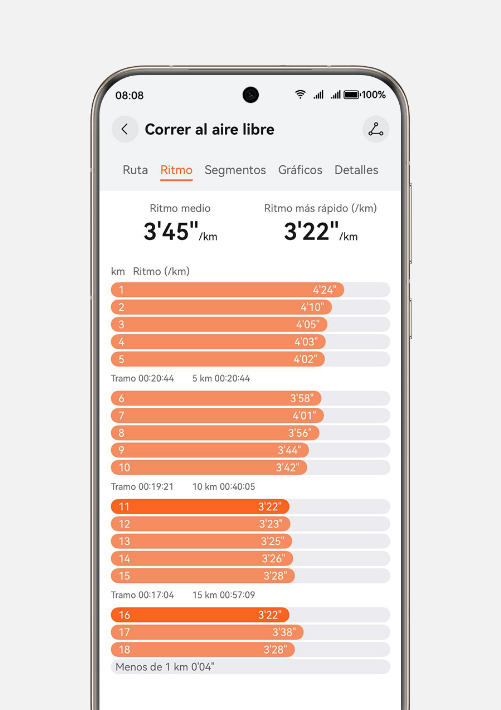
I have competed in international championships, I have experienced the pressure of an Olympic start, and I know what it means to go too fast at the beginning. In a marathon, pace is not important: it is decisive. Is it the most important thing? I would say it is what most influences the result. Even more than your current fitness level. You can be in peak physical condition, but if you mismanage the first 15 kilometres, you will pay the price at 35.

The most common mistake, both in popular and elite races, is to get carried away by the initial adrenaline rush. Your body feels light; the pace seems comfortable, but lactate is already building up. This is where your smartwatch ceases to be a complement and becomes a tool for competitive survival.

Turning A Goal into Reality: The Digital Pacer in the Race
When I prepare for a marathon with the goal of beating my personal best, we're talking about an
approximate finish time of 2:07:30, which implies an average pace of 3:01 min/km. But that
number alone is not enough. I break the marathon down into different segments.:
● First 10 kilometres:30:20 minutes (pace of 3:02 min/km)
● Kilometre 10–21:33:25 minutes (pace of 3:02 min/km)
● Kilometre 21–30:27:00 minutes (pace of 3:01 min/km)
● Last 12 kilometres (km 30–42): 36:45 minutes maintain 3:01 min/km or progress towards
3:00 min/km if you feel up to it.
The HUAWEI
WATCH GT Runner 2's race pace guidance system (officially called Marathon Guidance)
turns that abstract goal into a dynamic and constant reference point. It's not just about seeing
your instant pace: it's about receiving a real-time comparison between what you planned and what
you did.
How to use Marathon Mode step by step:
1. In the exercise section, select HUAWEI’s new “Marathon” mode.
2. Choose the distance you are going to run, whether it is a 5, 10km run, "half marathon,"
"marathon," or a custom distance.
3. Select the time goal you want to achieve for the selected distance.
4. The watch guides you with its voice assistant to automatically calculate the necessary pace
and determines during the run whether you are ahead of or behind the recommended plan.
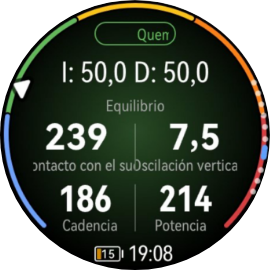


The most interesting thing is to see that the perceived effort closely matched the watch guide. I can made conscious adjustment following the watch's recommendation to increase my stride frequency. This alignment between objective data and subjective feeling is the key to a sustainable plan
Where do runners usually go wrong?
In fine control. Many amateur athletes run by feel, which can be misleading at the 5 km mark.
HUAWEI’s digital pacer avoids the most common mistake: starting too fast. Before the race, the
HUAWEI WATCH GT Runner 2 already calculates realistic finish time windows based on my training data
– I selected the
"Achievable" target of 3:00:21–3:15:11 – and from the very first metre it shows me my recommended
heart rate zone of 150–183 bpm. So, when my heart beats at 152 bpm, I know I'm exactly where I need
to be. The watch provides me with objective information when my mind starts to distort my
perception.


The Value of GPS: Ultra-Precision That Makes a Difference
When you compete with the world's elite, one second per kilometre ends up being a huge margin.
That's why GPS accuracy is a basic necessity. The dual-band GPS on the HUAWEI
WATCH GT Runner 2
provides essential accuracy in complex urban environments, partial tunnels or areas with tall
buildings. I was quite surprised by the accuracy of the maps displayed by this smartwatch, and I
could see the track where I train loaded on the map, even in Madrid's Casa de Campo, where you
can lose signal, as it is a large park with big trees where I often go to train.
After each special training session, especially when it comes to a marathon preparation test
such as a specific long run, I use the map afterwards to analyse:
● Curve tracings.
● Changes in pace associated with slopes.
● Micro variations in urban areas with buildings.
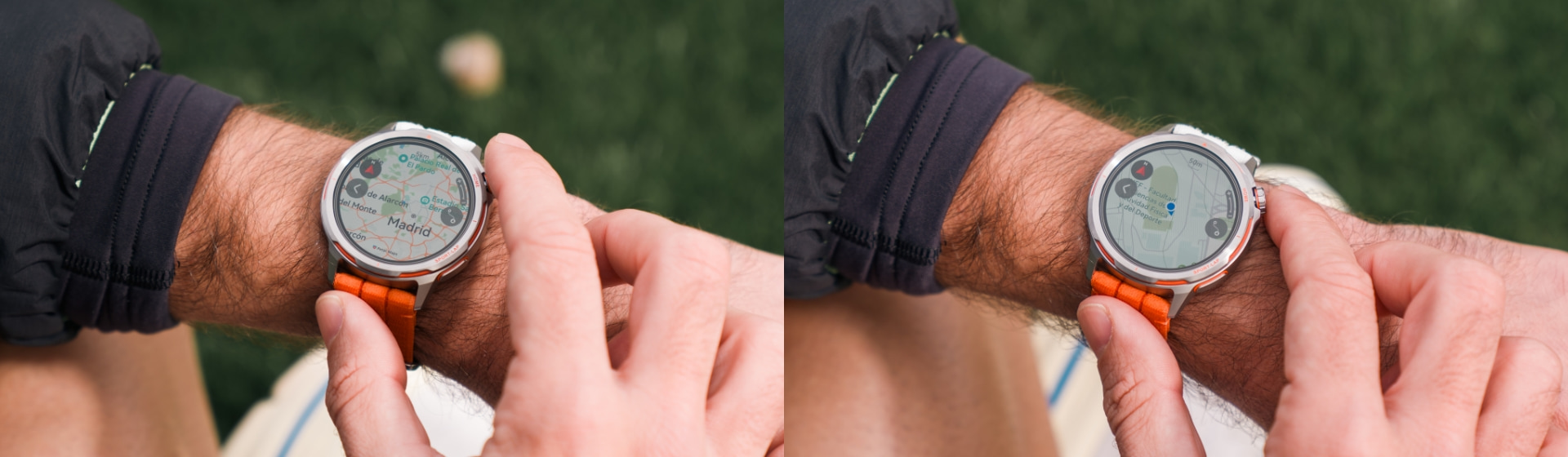

Master real-time pace with ultra-precision GPS
Intelligent Marathon Mode
Slim Design with Titanium
Accurate heart rate, HRV and ECG
GPS not only records where I ran, but also allows me to analyse energy distribution, evaluate tactical decisions and adjust future training sessions according to the actual profile of the route. And most importantly, it is directly linked to the pace control. Accuracy in positioning means accuracy in pace data.
“The GPS of the HUAWEI WATCH GT Runner 2 gives me the foundation on which I build my race pacing strategy. If the distance is accurate, my decisions are accurate too.”
From Invisible Training to Race Day
I train twice a day: sweat, rain, temperature changes, track sessions, gym. The watch has been
through all of it with me. The first thing I value is something really simple: that it doesn't
get in the way. At just 43.5g, the HUAWEI
WATCH GT Runner 2 is the lightest metal smartwatch I know -
and you feel it. It's stable, doesn't move even when the pace changes suddenly, and the AirDry
band keeps comfort consistent even on runs of over two hours.
In a marathon, any distraction is amplified – and when you're at kilometre 37, every little
detail adds to your mental fatigue. The battery is another critical factor. My training weeks
include long sessions with active GPS, constant heart rate measurement and post-session
analysis. I can't be charging my watch every day like a phone. According to the manufacturer,
the
HUAWEI WATCH GT Runner 2 offers up to 14 days of battery life and 32 hours of continuous
GPS
tracking.


The author of this article is Yago Rojo. The views expressed are his own.
The information is to be used as general information only, and is not to be taken as advice with respect
to any individual situation and cannot be relied upon as such. A healthcare provider should be consulted
when attempting to diagnose a condition or when determining the best course of action for any
health-related concern.
Users should exercise in a safe and suitable manner which is commensurate to their own exercise
capabilities and limits.
The heart rate feature is not a medical device, and therefore its monitoring data and results are for
reference only and should not be used as a basis for medical diagnosis or treatment.

Yago Rojo
Report
Read More
Explore


Copied